Why Is It Called Mira Road? The History Behind the Name
Discover what historical records tell us about the name Mira Road, the former Mira village and the development of Mira Bhayandar.
Every neighbourhood has a name, but the story behind that name is not always obvious. For residents of Mira Road, one natural question is where the word “Mira” came from and how it became associated with one of Mumbai's well-known suburbs. The answer begins with the history of the wider Mira Bhayandar region and the older village settlements that existed before modern residential development. Although the name is familiar to millions of commuters and residents, it is important to distinguish documented administrative history from popular explanations that may not have been verified.
The connection with Mira village
The Mira Bhayandar region developed from several village settlements. The official history published by Mira Bhayandar Municipal Corporation records that the municipality was established on 12 June 1985 through the merger of five village panchayats: Bhayandar, Navghar, Mira, Kashi and Ghodbunder.
Mira was one of the five village panchayats named in MBMC's official municipal history. This record establishes that Mira was the name of an older village-level administrative unit in the region.
The name Mira Road is therefore closely associated with the area's historical geography and the settlement that existed before the modern suburb expanded. However, the municipal record does not, by itself, establish the deeper linguistic origin of the word “Mira.” It would be inaccurate to present a particular religious, personal or linguistic explanation as fact without additional documentary evidence.
Do not present a specific story about the word's linguistic or personal origin as fact without a reliable historical source. The municipal record confirms the village existed — it does not explain the etymology of the word itself.
From a village name to a modern suburb
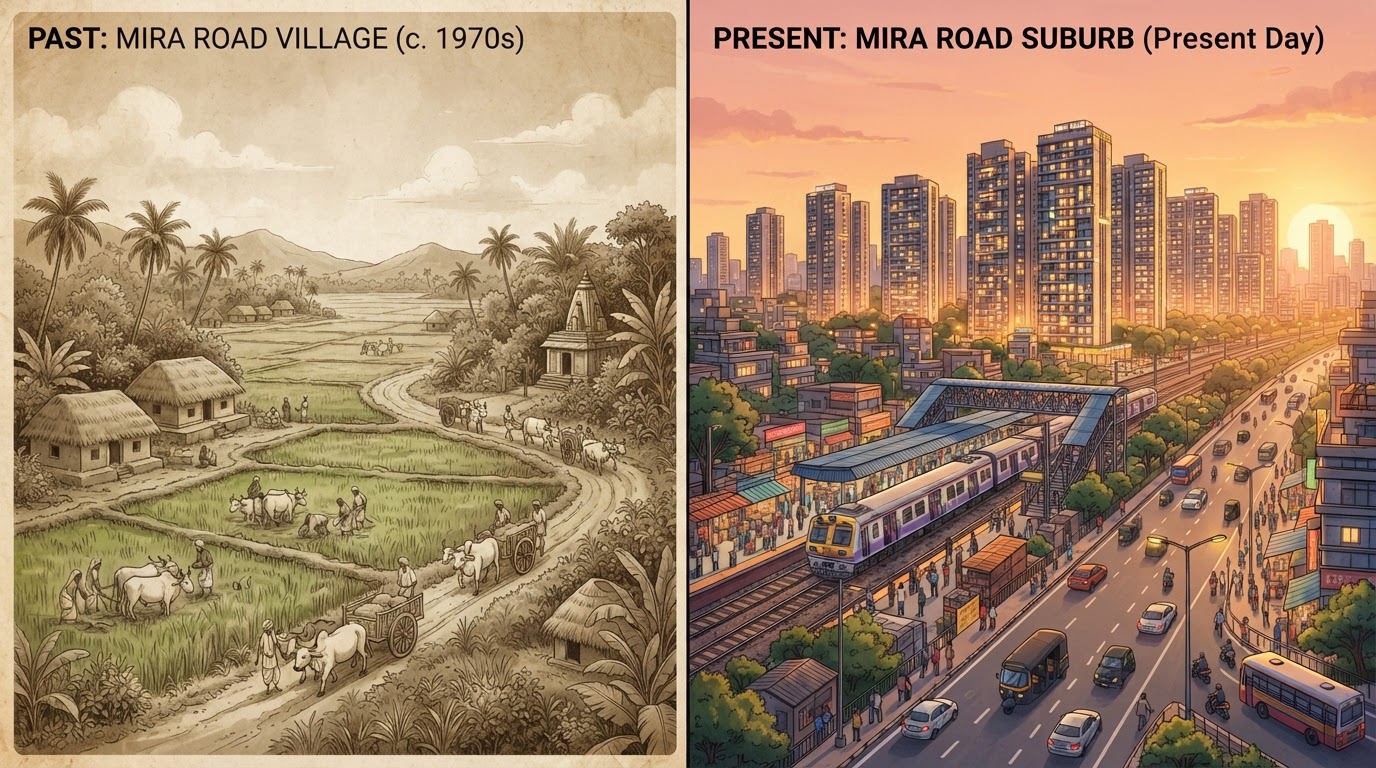
Place names often survive major changes in how an area is used. A locality that once referred primarily to a village may later become associated with railway stations, roads, residential neighbourhoods, markets and a much larger urban population. Mira Road illustrates this broader pattern of urban change.
The name now identifies a large suburban area, but its connection with the older Mira settlement provides a link to the region's earlier administrative geography. This is one reason why researching the history of a modern suburb requires looking beyond contemporary maps. Older village records, land documents and government notifications can reveal how familiar names became part of a much larger urban landscape.
Was Mira Road originally a separate village?
The answer requires careful wording. The MBMC's municipal history lists Mira among the village panchayats involved in the municipality's formation. This confirms the administrative importance of Mira as a settlement.
The municipal record does not mean that today's entire Mira Road neighbourhood had exactly the same boundaries as the former village. Modern localities can expand beyond the boundaries of earlier settlements, and neighbourhood names may be used differently in everyday speech than in official records.
For a precise historical map, researchers would need to compare village maps, revenue records and municipal boundary documents from different periods.
What about alternative spellings and stories?
Residents may encounter different spellings or stories explaining the origin of the name. Such accounts can be valuable leads for further research, particularly when they come from long-term residents or older documents. But a spelling variation or repeated anecdote is not enough to establish an official etymology.
A reliable history article should distinguish three things:
- Documented fact: Mira was one of the village panchayats named in MBMC's official municipal history.
- Historical interpretation: The modern locality's name is connected with the older settlement.
- Unverified explanation: A specific story about the word's linguistic or personal origin that has not been supported by a reliable historical source.
This distinction helps preserve local stories without accidentally turning an unverified explanation into a historical fact. Personal recollections should be attributed to the people who share them and separated from independently verified facts.
How the name became part of everyday life
Today, Mira Road is used in residential addresses, railway journeys, business listings, property advertisements and directions. For many residents, the name is connected with their daily commute, their housing society, local markets and the places where they grew up.
As the area developed, the name acquired a wider identity beyond its older settlement history. That evolution is common in expanding cities: a name rooted in a smaller locality can become the recognised name of a much larger urban neighbourhood.
How MiraRoad.blog can investigate the name's origin further
A deeper account would benefit from primary historical research. Useful sources would include:
- Older village and revenue maps.
- Historical land records for Mira village.
- Government gazette notifications.
- District gazetteers and historical surveys.
- Historical railway and road maps.
- Interviews with long-term residents, clearly attributed as oral history.
If an older document establishes a particular explanation for the name, the article can be updated with a quotation, date and source reference. Until then, the documented village connection is the strongest verified link.
Conclusion
The name Mira Road connects the modern suburb with the older settlement history of Mira Bhayandar. Official municipal records provide a starting point, but the complete story of the name requires further work with historical maps, land records and local oral histories.
By separating documented facts from unverified explanations, MiraRoad.blog can help preserve the area's history while keeping its readers accurately informed.
Verified & Curated
Researched from official, named sources
Mira Bhayandar Municipal Corporation (About Us) and the MBMC Town Planning Department.
Enjoying this story?
Get the best of Mira Road — local news, food finds and weekend plans — straight to your inbox.
Team Mira Road Blog
The editorial team behind MiraRoad.blog — covering local news, food, events and everything Mira Road & Mira Bhayandar, one story at a time.
Frequently asked questions
The municipal history establishes Mira as one of the village panchayats associated with the formation of Mira Bhayandar Municipality. The deeper linguistic origin of the name requires additional historical evidence.
Mira is listed in MBMC's official account of the village panchayats that formed the municipality in 1985.
No. Popular explanations should be checked against historical documents before being presented as established fact.
Made for Mira Road. Built for the community.
Your neighbourhood, one story at a time.